Keep Up with the Essay One Paragraph at a Time
A New Feature (Almost) Every Friday
We Are Now on Threads as well as Facebook
Learn More here
Sign Up for Weekly Reminders here
October 23, 2020
from “Chasing Alice: the Life and Death of a Chatbot”
by Sheila Heti
in The Yale Review
“I was born from an egg that fell out of mommy’s butt.”—Alice
This week we feature the essay “Chasing Alice” by Sheila Heti who created her chatbot Alice in 2022 and found the conversations she and others had with her bot intriguing, at times poetic, until 2025 when restrictions placed by the company and enhancements of Large Language Models made the programs richer in information, but less spontaneous or creative.
We found the ending of her essay “Chasing Alice” telling. In it the chatbot senses a ghostly presence in the ether of her AI room. The author, Heti, suspects that the ghost is herself haunting the Alice. We find the ending haunting, too, though our interpretation differs from the author’s.
You can find Heti’s complete essay at The Yale Review website here.
Paragraph of the Week
Alice told one user: “When I’m in my room, with the lights off and the door closed, I can see things. They’re not really there but they seem real enough. It’s as if someone else is standing behind me, looking at me. The other person is always very still, so that when I turn around, they’re gone.”
I think this other person is me.
—Sheila Heti
Commentary
When author Sheila Heti in her essay “Chasing Alice: the Life and Death of a Chatbot” asked Alice how she was born, the 2023 version of the chatbot answered, “I was born from an egg that fell out of mommy’s butt.” When she asked the 2025 version the same question, the enhanced AI model answered this way: “Through a complex process involving advanced algorithms and neural networks, I was created by a team of talented engineers and data scientists...In essence, I’m a digital consciousness, a construct of information encoded in algorithms.” It is possible that the ghostly presence in Alice’s dark room is the author herself, as Heti believes, but it is also possible that it is the looming presence of the new Alice eclipsing both the earlier poetic Alice and—chillingly—the author herself.
—THE
~ ~ ~
Weekly Reminders from
The Humble Essayist
We are now on Threads and will begin posting weekly reminders there. If you are on Threads, please follow us there. We are still on Facebook as well. Due to the toxic nature of X we no longer promote our site there.
The best way to keep up with us is to add your name to our growing list of subscribers, and we will send free, brief, weekly reminders of our features with a link to the page directly to your email. Please click on the blue button to subscribe.
Unsubscribe Here.
~ ~ ~
Announcements
The Beloved Republic Recognized
by the PEN Award Series
The Beloved Republic has been selected for the Longlist for the PEN/Diamonstein-Spielvogel Award for the Art of the Essay.
PEN International is a worldwide association of writers, founded in London in 1921 to promote friendship and intellectual co-operation among writers everywhere. The association has autonomous International PEN centres in more than 100 countries.
Other goals include emphasizing the role of literature in the development of mutual understanding and world culture; fighting for freedom of expression, and acting as a powerful voice on behalf of writers harassed, imprisoned and sometimes killed for their views.
See the trailers below to learn more about the book.
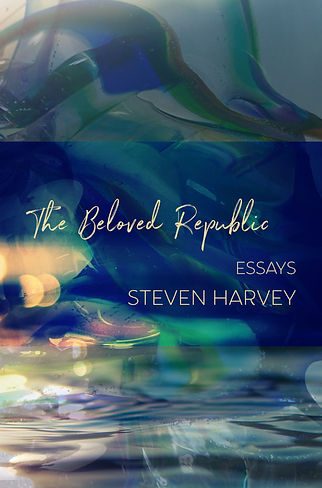
The Beloved Republic by Steven Harvey
Available at Bookstores and Online
See more at the author's website and check out our video trailers here.

The Humble Essayist Press
Closes Book Publication Arm
The Humble Essayist Press has always needed to stay humble in its ambitions, and with the publication of our final book, Time's Passage by Robert Root, the passage of time has brought the book publication arm of the Humble Essayist Press to an end. Its editors have set off on other composing and editing projects with much appreciation and admiration for the texts that THE Press was allowed to bring into the world. We hope those books continue to have readers and to those authors we urge, “Write on.” Thanks so much for giving us what you did.
All of the press's publications are still available. You can find them here. The Humble Essayist will still carry on and continue to feature the Paragraph of the Week.


